Image courtesy of Colonial National Historical Park, Yorktown.

Wednesday, January 3, 2024

Next Meeting: January 18, 2024

Our next meeting will be January 18, 2024. This will be a ZOOM ONLY meeting and will begin at 6:30 p.m. The meeting link will be included in Bill's January newsletter.

Dr. Benjamin Carp will be speaking on "The Boston Tea Party and Its Legacy at 250." Ben is the Daniel M. Lyons Professor of American History at Brooklyn College and teaches at the CUNY Graduate Center. He is the author of The Great New York Fire of 1776: A Lost Story of the American Revolution (2023) and Defiance of the Patriots: The Boston Tea Party and the Making of America (2010), which won the triennial Society of the Cincinnati Cox Book Prize in 2013; and Rebels Rising: Cities and the American Revolution (2007).  He has written about nationalism, firefighters, Benjamin Franklin, and Quaker merchants in Charleston. He has also written for Colonial Williamsburg, the New York Daily News, the Wall Street Journal and the Washington Post. He previously taught at the University of Edinburgh and Tufts University.


Monday, December 11, 2023

2024 Meeting Dates, Topics, and Speakers

Our schedule of meetings is set for 2024. Click on the Meetings tab above to see the dates, topics, and speakers. Our new 1st Vice President has lined-up a wonderful slate of speakers for us... thank you, Randy!

As a reminder, our January meeting will be ZOOM ONLY. Details will be in our January newsletter.

Meeting Notes: November 15, 2023

The November 15, 2023, meeting was held in the Westhampton Room, Heilman Dining Center, at the University of Richmond. Meeting attendance continues to grow towards pre-pandemic numbers.

Bill Welsch announced the retirement of Dr. Bruce Venter as 1st Vice President of Programs and thanked him for 15 years of truly significant, selfless, and important services to the Round Table. In recognition of his contributions, Bill presented Bruce a certificate of appreciation and an engraved Jefferson Cup. Bruce is an author, tour leader, and president of America's History, LLC, and conducts conferences for history enthusiasts (https://americashistoryllc.com).  Bill announced that Randy Flood, Host and Executive Producer of The Real American Revolution Multimedia Center & Consortium for Civic Education, has been selected by the Board to replace Bruce. Randy will assume the position on January 1, 2024.

The evening’s presenter was Bob Thompson, author of Revolutionary Roads, Searching for the War That Made America Independent...and All the Places It Could Have Gone Terribly Wrong, published by: Twelve Books (https://www.hachettebookgroup.com/titles/bob-thompson/revolutionary-roads/9781455565153/).

Bob Thompson, a longtime feature writer for the Washington Post, is known for his pieces on the intersection of history and myth. His book Revolutionary Roads, Searching for the War That Made America Independent...and All the Places It Could Have Gone Terribly Wrong was the product of his curiosity about which Revolutionary War battles were turning points towards victory and the actions of some relatively unfamiliar individuals and groups. His presentation focused on not so much battles and strategies but how he researched the stories he wanted to tell when Patriot forces encountered British and Loyalist forces and the outcome was uncertain or could have gone terribly wrong for either side. He described his travel history of going to battlefields, walking the ground, and seeking out local experts, from Quebec to Savannah, learning their stories of historical events and separating out mythical spins.

He presented examples of moments that played key roles in shaping the course of the war and, ultimately, the outcome of the American Revolution. Thompson emphasized his walks seeking out battlefield guides and revolutionary war enthusiasts gathering facts to pass along and educate future readers of a planned book. Speaking briefly about the Battle of Brooklyn (also known as the Battle of Long Island) that allowed Washington a nighttime retreat and saving a significant portion of his army. Thompson made his way through the 2nd Battle of Trenton, then spoke about his research methodologies concerning the nearly (or not so) famous Americans involved in particular actions like the Philadelphia dock workers, Brandywine, Monmouth, Charleston, Savannah, King’s Mountain, Saratoga, Cornwallis’ decision at Wilmington, African Americans (both enslaved and free) performing military duties in the Continental Army, and how the French fleet sailed to the Caribbean and then northward into Chesapeake Bay cutting off the British escape route by sea and trapping the British at Yorktown. Each a combination of strategic decisions, tactical competence or incompetence, and sometimes pure happenstance contributed to preventing potential disasters and leading to eventual victory for the United Colonies’ forces.

Fred Sorrell

Secretary

Wednesday, October 11, 2023

Next Meeting: November 15, 2023

Our next meeting on November 15 will feature a presentation by Bob Thompson on "Revolutionary Roads: Searching for the War that Made America Independent... and All the Places It Could Have Gone Terribly Wrong." Be sure to mark your calendars now!

We will be returning to the Westhampton Room in the Heilman Dining Center. Regular dining service will be available beginning at 5:30 p.m. and the meeting will follow at 6:30 p.m.

University of Richmond campus map:

THIS IS NOT A ZOOM MEETING, BUT IN-PERSON ONLY AT THE UNIVERSITY OF RICHMOND.

Meeting Notes: September 20, 2023

Meeting was held September 20, 2023, in the Westhampton Room, Heilman Dining Center, University of Richmond

 Meeting attendance is increasing. Bethany Sullivan, Director of The James Madison Museum of Orange County Heritage (https://www.thejamesmadisonmuseum.net) attended the meeting and spoke about the 18th, 19th and 20th century cultural heritage and artifacts located at the Museum, of Orange County and the Piedmont region of Virginia.

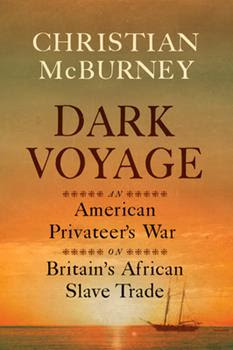
 The evening’s presentation was “The Unintended Consequences of Interrupting Britian’s Slave-trading Economy.” The speaker was Christian McBurney, author of Dark Voyage: An American Privateer’s War on Britain’s African Slave Trade. His books are available from his publisher (https://www.westholmepublishing.com/?s=mcburney).

 An armada of more than 2,000 so-called “privateers” were legally commissioned, by both the Continental Congress and individual states, to seize enemy shipping on both sides of the Atlantic Ocean in hopes of collecting court-awarded vessels as prizes whereby seized ships and contents could then be sold. The ship’s owners, crews and investors profited by selling the captured vessels and contents. This severely disrupted Great Britain’s global commerce and turned British public opinion against the war as British officials complained they could not guarantee the safety of civilian trade. Privateering advanced America’s War of Independence objectives by diminishing the importation of British goods into the United Colonies and the exportation of natural resources to Great Britain. Privateers became “our cheapest and best navy.” Seized merchant ships were later sold to American traders and syndicates (and others masking as American) who repurposed the ships expanding commercial capacity for the slave trade.

 Christian McBurney’s presentation “followed the money” of ships and investors from Portugal, Spain, the Dutch Republic, France, and Britain leading up to slave-trading throughout the Americas. This occurred when the demand for enslaved labor rose sharply with the growth of sugar cane agriculture in the Caribbean and tobacco plantations in the Chesapeake region. He described how European naval commerce developed as triangular trade ventures proved profitable: in which arms, textiles, and wine were shipped from Europe to Africa; enslaved people were transported from Africa to Brazil, the Caribbean islands, and North America; and sugar, and its derivatives rum and molasses, and coffee were shipped from the Americas to Europe.

 At the start of the American War of Independence, Britain dominated Atlantic commerce and was the leading slave-trading nation in the world. In 1776, American privateers began to prey on British merchantmen exploiting opportunities for immediate profits. Privateers began to capture British slave ships with African captives on board just before they arrived at their Caribbean Island destinations, and North American coasts, returning the seized ships to port to declare and await award their prizes. Privateers later expanded their roaming to the western coast of Africa.

 Based on a little-known contemporary primary source, The Journal of the Good Ship Marlborough, one privateer was given an extraordinary task: to sail across the Atlantic to attack British slave trading posts and ships on the coast of West Africa. The story of this remarkable voyage is told in McBurnie’s book. He attributes the work of the Marlborough and other American privateers as so disruptive that it led to an unintended consequence: virtually halting the British slave trade. British slave merchants, alarmed at losing money from their ships being captured, invested in fewer slave voyages. As a result, tens of thousands of Africans were not forced onto slave ships, then transported to the New World, and consigned to a lifetime of slavery or an early death.
Monday, August 14, 2023

Next Meeting: September 20, 2023


Our speaker will be Christian McBurney, president of the George Washington ARRT-DC and the author of a number of Revolutionary War books.  He will be speaking about his newest, Dark Voyage: American Privateer's War on British African Slave Trade, describing one privateer's extraordinary task: to sail across the Atlantic to attack British slave trading posts and ships on the coast of West Africa.  Christian is a return guest, having previously presented on both the capture and court martial of General Charles Lee.  His books are available at the Fort Plain Bookstore.

                                    
We will be returning to the Westhampton Room in the Heilman Dining Center. Regular dining service will be available beginning at 5:30 p.m. and the meeting will follow at 6:30 p.m.

University of Richmond campus map:

THIS IS NOT A ZOOM MEETING, BUT IN-PERSON ONLY AT THE UNIVERSITY OF RICHMOND.

Wednesday, July 5, 2023

Next Meeting: July 19, 2023

 "Revolutionary Money & Finance," Edward Lewis

The Currency Act or Paper Bills of Credit Act was legislation passed by the British Parliament that regulated paper money issued by the colonies.  Ed will discuss this, as well as revolutionary finance in general.  He will also present bills and coins for our inspection.
 
Edward Lewis has studied the American Revolution for fifty years, with an emphasis on money and finance. He became interested in the American Revolution in the early 1970s, tracing ancestors who served in the Continental Army, including Cresaps Maryland Rifles Company.  He has collected all types of currency and documents  related to the revolution, signers of the Declaration of Independence, and the US Constitution. Ed is a member of the Chesterfield Historical Society and three coin clubs in the Richmond, Colonial Heights, and Charlottesville areas.
 
                                    
THIS IS AN IN-PERSON MEETING in the HEILMAN DINING CENTER

 DINNER FROM 5:00 - 6:00 PM, MEETING BEGINS AT 6:00 PM